
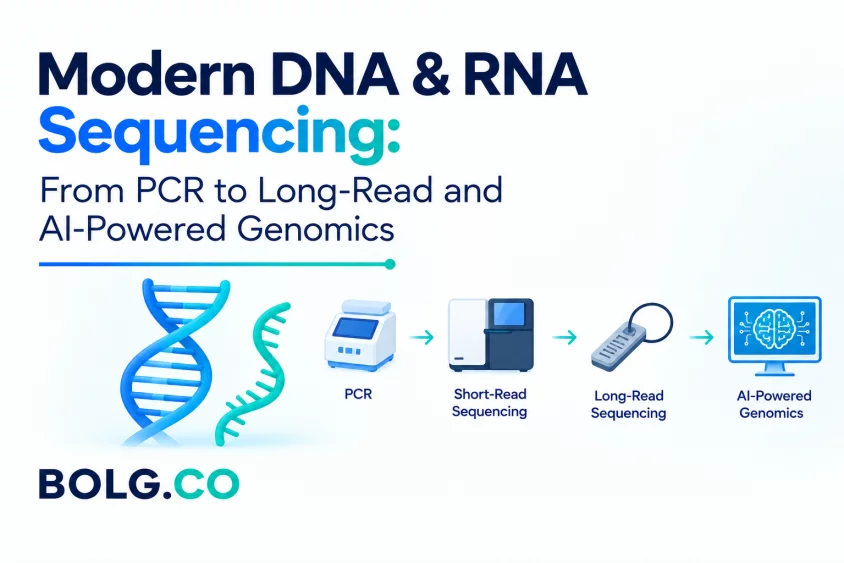
🧬 Modern DNA & RNA Sequencing: From PCR to Long-Read and AI-Powered Genomics
Introduction: Decoding the Language of Life
DNA and RNA sequencing have transformed modern biotechnology, enabling scientists to investigate genetic variation, understand gene expression, identify disease-associated mutations, and explore biological processes at unprecedented resolution.
From the development of Sanger sequencing to next-generation sequencing (NGS), long-read technologies, and artificial intelligence (AI)-powered bioinformatics, molecular analysis has evolved into a powerful collection of complementary methods.
Today, researchers can investigate entire genomes, quantify specific nucleic acids, analyze thousands of genes simultaneously, and explore gene expression within individual cells.
This article explores the fundamental principles, applications, and emerging advances of major DNA and RNA analysis technologies, including PCR, quantitative PCR, digital PCR, whole-genome sequencing, targeted sequencing, RNA-seq, single-cell sequencing, and long-read transcriptomics.
The future of genomics is not simply about reading genetic information—it is about understanding how that information shapes life.
1. Sanger Sequencing: The Foundation of DNA Analysis
Developed in the 1970s, Sanger sequencing was a major breakthrough in molecular biology. It determines the order of nucleotide bases in DNA using chain-terminating nucleotides and DNA synthesis.
In modern Sanger sequencing, fluorescently labeled DNA fragments are separated by capillary electrophoresis, and the resulting signals are used to reconstruct the DNA sequence.
Despite the rise of high-throughput sequencing, Sanger sequencing remains valuable for confirming selected genetic variants, verifying cloned DNA, and analyzing individual PCR products.
Its main limitation is relatively low throughput, making it less suitable for large-scale genomic studies.
Nevertheless, Sanger sequencing remains an important foundation for understanding how modern sequencing technologies work.
2. PCR, qPCR, and Digital PCR: Amplifying and Quantifying Nucleic Acids
The polymerase chain reaction (PCR) enables researchers to amplify a specific DNA region, producing many copies from a small amount of starting material. It is widely used in molecular diagnostics, genetic research, cloning, and sequencing workflows.
Three major approaches are particularly important.
Conventional PCR amplifies a selected DNA target through repeated cycles of denaturation, primer annealing, and DNA synthesis. The resulting product can be analyzed using methods such as gel electrophoresis or DNA sequencing.
Quantitative PCR (qPCR) measures DNA amplification in real time using fluorescent signals. When RNA is converted into complementary DNA before quantification, the method is called reverse-transcription quantitative PCR (RT-qPCR). These techniques are widely used for gene-expression studies, pathogen detection, and molecular biomarker analysis.
Digital PCR (dPCR) divides a sample into numerous individual reaction partitions. By measuring positive and negative partitions, researchers can estimate target concentration using statistical methods. Digital PCR can be particularly useful for quantifying low-abundance targets and selected genetic variants.
Although these methods are related, they serve different purposes. PCR amplifies DNA, qPCR monitors amplification, and dPCR estimates target concentration through partition-based measurements.
Key takeaway: PCR-based methods remain essential tools for targeted molecular analysis, while sequencing provides broader information about nucleotide sequences and genetic variation.
3. Next-Generation Sequencing: A Revolution in Genomics
Next-generation sequencing (NGS) transformed genomics by enabling millions of DNA fragments to be sequenced in parallel.
Unlike Sanger sequencing, which typically analyzes individual DNA fragments, NGS generates large datasets that can support the simultaneous investigation of thousands or millions of genomic regions.
A typical NGS workflow includes nucleic acid extraction, library preparation, sequencing, quality control, computational analysis, and biological interpretation.
Major applications include genetic disease research, cancer genomics, microbial identification, transcriptomics, and precision medicine.
Whole-Genome Sequencing
Whole-genome sequencing (WGS) analyzes DNA across an organism's genome. Depending on sequencing technology and analytical methods, it can identify single-nucleotide variants, small insertions and deletions, and many structural variants.
WGS is widely used in rare disease research, cancer studies, population genetics, microbial genomics, and evolutionary biology.
Targeted Sequencing
Targeted sequencing focuses on selected genes or genomic regions associated with a particular research question. By concentrating sequencing resources on predefined targets, researchers can investigate relevant regions in greater depth.
Targeted sequencing is useful when the objective is to study a known group of genes rather than characterize the entire genome.
Amplicon Sequencing
Amplicon sequencing combines PCR amplification with NGS. Researchers amplify selected DNA regions and sequence the resulting products at high throughput.
Applications include microbiome profiling, pathogen characterization, targeted variant analysis, and environmental DNA research.
Although these methods differ in scope, they share a common objective: extracting useful genetic information from biological samples.
4. Long-Read Sequencing: Revealing Complex Genomic Structures
One of the most important advances in modern genomics is the development of long-read sequencing, which allows researchers to analyze much longer DNA or RNA molecules than conventional short-read approaches.
Two major platforms are Pacific Biosciences (PacBio), including HiFi sequencing, and Oxford Nanopore Technologies.
PacBio HiFi sequencing generates highly accurate consensus reads, while nanopore sequencing detects electrical signal changes as nucleic acid molecules pass through nanopores. Nanopore platforms can also support real-time analysis and, in suitable workflows, direct RNA sequencing.
Long-read sequencing is particularly useful for:
Detecting complex structural variants.
Resolving repetitive genomic regions.
Improving genome assembly.
Determining haplotypes.
Characterizing full-length RNA transcripts.
Investigating alternative splicing.
Studying selected DNA modifications.
Short-read sequencing remains highly effective for many applications, including large-scale expression analysis. Long-read technologies provide complementary advantages when longer-range genomic or transcript information is required.
The continued development of these platforms is helping researchers investigate genomic regions and transcript structures that were previously difficult to resolve.
5. RNA Sequencing: Understanding Gene Expression
While DNA sequencing reveals genetic information, RNA sequencing (RNA-seq) provides insight into how genes are expressed under particular biological conditions.
RNA-seq can identify expressed genes, quantify transcript abundance, investigate alternative splicing, and discover previously uncharacterized RNA molecules.
In conventional workflows, RNA is converted into complementary DNA before sequencing. Specialized methods can also analyze selected RNA classes or sequence RNA molecules directly.
Bulk RNA-seq
Bulk RNA-seq measures RNA from a population of cells or a tissue sample. It is widely used to compare gene expression between healthy and diseased tissues, treated and untreated samples, or different experimental conditions.
However, bulk measurements average signals across the sample and may conceal differences between individual cell populations.
Small RNA Sequencing
Small RNA-seq focuses on short RNA molecules, including microRNAs and other regulatory RNAs. These molecules can influence gene expression and have been investigated in cancer, development, immune responses, and other biological processes.
Specialized library preparation is required because short RNA molecules differ from longer transcripts in their molecular properties.
Isoform Sequencing
Many genes produce multiple RNA transcript isoforms through alternative splicing and other RNA-processing mechanisms. Different isoforms may have distinct biological functions, regulatory properties, or protein products.
Long-read RNA sequencing can help researchers reconstruct full-length transcripts and distinguish isoforms that are difficult to resolve using short reads alone.
Together, RNA-seq, small RNA-seq, and isoform analysis provide complementary perspectives on gene activity and RNA biology.
6. Single-Cell and Single-Nucleus RNA Sequencing
Biological tissues contain diverse cell populations, each potentially expressing different genes. Traditional bulk RNA-seq averages their molecular signals, which can conceal important cellular differences.
Single-cell RNA sequencing (scRNA-seq) measures gene-expression profiles at the level of individual cells. It can help identify rare cell populations, investigate tumor heterogeneity, characterize immune-cell states, and study cellular development.
In many workflows, individual cells or their RNA molecules receive unique barcodes, allowing sequencing reads to be assigned to their cells of origin.
Single-nucleus RNA sequencing (snRNA-seq) instead analyzes RNA from isolated nuclei. It can be particularly useful for frozen tissues and samples in which obtaining intact individual cells is difficult.
The two approaches are complementary. Single-cell methods can capture both nuclear and cytoplasmic RNA, depending on the protocol, whereas single-nucleus methods emphasize nuclear RNA and may provide a different view of gene expression.
Single-Cell Long-Read Transcriptomics
An emerging direction combines single-cell barcoding with long-read sequencing. This approach aims to identify not only which genes are expressed in individual cells, but also which transcript isoforms those cells produce.
It could improve understanding of alternative splicing, cell-specific transcript diversity, and gene regulation.
However, these methods continue to face challenges involving sequencing depth, transcript recovery, cost, and computational analysis.
7. AI-Powered Genomics and Bioinformatics
Modern sequencing technologies generate enormous volumes of biological data. Bioinformatics transforms these data into interpretable information through computational analysis.
Typical workflows include sequence quality control, alignment or assembly, variant detection, transcript quantification, statistical analysis, and biological interpretation.
Artificial intelligence is increasingly supporting several aspects of this process.
AI-based methods can assist with:
Base calling from sequencing signals.
Genetic variant prioritization.
Gene-expression analysis.
Single-cell clustering and cell-type annotation.
Transcript and isoform prediction.
Identification of patterns in complex genomic datasets.
Integration of genomic and other molecular measurements.
Biological foundation models are also being explored for analyzing DNA, RNA, and protein sequences, potentially helping researchers predict sequence properties and investigate biological relationships.
However, computational predictions are not automatically correct. Models can be affected by biased training data, limited generalizability, and uncertainty in biological interpretation.
Reliable genomic analysis therefore requires suitable controls, independent validation, transparent reporting, and scientific judgment.
AI can accelerate genomic discovery, but experimental evidence remains essential for establishing biological function.
8. Applications Across Biotechnology and Medicine
The combination of sequencing, molecular detection, and computational analysis supports a wide range of applications.
Precision medicine: Genomic analysis can help identify disease-associated variants and, in appropriate clinical settings, inform diagnostic or treatment decisions.
Cancer research: DNA sequencing and RNA-seq can characterize tumor-associated mutations, gene-expression changes, and differences among cellular populations.
Rare disease research: WGS, whole-exome sequencing, targeted sequencing, and RNA analysis can help investigate suspected inherited disorders.
Infectious disease research: PCR and sequencing technologies support pathogen detection, genetic characterization, outbreak investigation, and the study of antimicrobial resistance.
Microbiome research: Amplicon sequencing and shotgun metagenomics help characterize microbial communities, although they provide different levels of information about community composition and functional potential.
Regenerative medicine and developmental biology: Single-cell and single-nucleus methods help researchers investigate cellular differentiation, tissue development, and responses to experimental interventions.
Agricultural and environmental biotechnology: Sequencing supports crop improvement, biodiversity research, microbial discovery, and environmental monitoring.
The choice of technology depends on the biological question, sample type, required sensitivity, available resources, and desired level of resolution.
9. The Future of DNA and RNA Sequencing
Sequencing technology continues to advance in several interconnected directions.
More complete genome analysis: Long-read sequencing and improved computational methods are helping researchers characterize repetitive regions, structural variants, and complex genomic architectures.
Single-cell isoform analysis: Combining single-cell methods with long-read sequencing could reveal how transcript structures vary between individual cells.
Real-time sequencing: Certain platforms can analyze sequence data as they are generated, supporting time-sensitive research and selected applications outside conventional laboratory settings.
Multi-omics integration: Combining genomics, transcriptomics, epigenomics, proteomics, and spatial profiling can provide a more comprehensive understanding of biological systems.
AI-driven interpretation: Improved computational models may help researchers prioritize genetic variants, analyze transcriptomic data, and uncover relationships across large biological datasets.
Despite this progress, challenges remain. Data quality, experimental reproducibility, computational requirements, privacy, and responsible interpretation will continue to shape the adoption of new technologies.
The future of genomics will depend not only on better sequencing instruments, but also on the ability to connect molecular measurements with reliable biological understanding.
Conclusion: From Reading DNA to Understanding Life
The evolution of DNA and RNA sequencing has transformed biotechnology from the targeted analysis of individual DNA fragments into comprehensive investigations of genomes, transcriptomes, and individual cells.
Sanger sequencing established the foundations of modern DNA analysis. PCR, qPCR, and digital PCR expanded the ability to amplify and quantify nucleic acids. NGS enabled large-scale genomic studies, while long-read technologies improved the investigation of complex DNA structures and full-length RNA transcripts.
RNA-seq, small RNA sequencing, single-cell analysis, and isoform sequencing continue to reveal how genetic information is expressed and regulated. Meanwhile, AI-powered bioinformatics is helping researchers interpret increasingly complex biological datasets.
No single technology answers every biological question. The most effective research combines appropriate methods with careful experimental design, robust data analysis, and critical interpretation.
As these technologies continue to converge, they will create new opportunities across molecular biology, precision medicine, synthetic biology, and biotechnology.
🚀 Explore the Future of Genomics with BOLG
At BOLG, we believe that understanding the language of life is a powerful step toward understanding and shaping the future of biotechnology.
Whether you are learning molecular biology fundamentals, exploring PCR and sequencing methods, discovering bioinformatics, or investigating cutting-edge genomic technologies, BOLG helps make complex scientific concepts more accessible to aspiring scientists and life-science professionals.
DNA holds the information. Sequencing reveals its details. Bioinformatics helps uncover its meaning. Knowledge empowers the next generation of discovery.
🧬Dive into the world of genomics with BOLG —expand your scientific knowledge, explore tomorrow's technologies, and unlock your potential to contribute to the future of life sciences.