
🧫 4D Bioprinting: Engineering Living Tissues That Grow, Adapt, and Self-Transform
Introduction: Beyond 3D Bioprinting
The emergence of 3D bioprinting transformed tissue engineering by enabling researchers to fabricate complex biological structures layer by layer using living cells and biomaterials. While this technology has significantly advanced regenerative medicine, researchers are now taking biofabrication one step further through the revolutionary concept of 4D bioprinting.
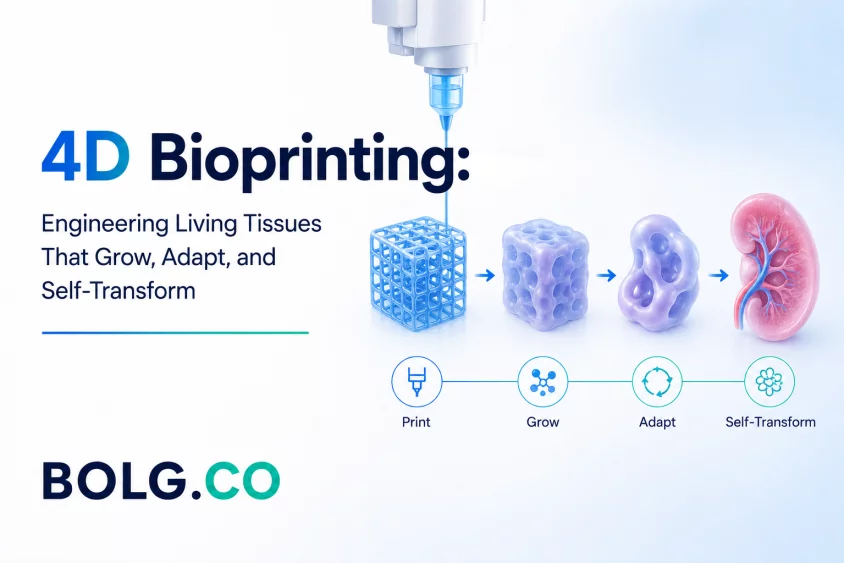
Unlike traditional 3D-printed tissues, 4D-bioprinted constructs are dynamic rather than static. They are designed to change their shape, mechanical properties, or biological function over time in response to specific environmental stimuli. This fourth dimension—time—allows engineered tissues to behave more like living biological systems, adapting to their surroundings and evolving after fabrication.
By integrating advances in biotechnology, biomaterials science, synthetic biology, tissue engineering, and biofabrication, 4D bioprinting is opening new frontiers in regenerative medicine, personalized healthcare, and biomedical research.
What Is 4D Bioprinting?
4D bioprinting is the next generation of biofabrication technology in which living tissues are printed using stimuli-responsive biomaterials, also known as smart bioinks.
Unlike conventional printed tissues that remain unchanged after fabrication, 4D-bioprinted constructs are engineered to respond predictably to environmental conditions such as:
Temperature
pH
Moisture
Light
Magnetic fields
Mechanical forces
Chemical signals
These responses enable the printed structure to fold, expand, contract, reorganize, or mature into functional biological architectures over time.
In essence, 4D bioprinting allows scientists to program biological transformation, bringing engineered tissues closer to the remarkable adaptability of natural living systems.
The Science Behind the Fourth Dimension
The defining characteristic of 4D bioprinting is programmable transformation.
This transformation is achieved through the integration of several key components:
Smart Biomaterials
Smart biomaterials can dynamically alter their physical or chemical properties in response to environmental changes.
Examples include:
Thermoresponsive hydrogels
Shape-memory polymers
pH-sensitive biomaterials
Light-responsive polymers
Magnetic nanocomposite hydrogels
These materials serve as the structural foundation that enables dynamic tissue behavior.
Living Cells
Stem cells, primary cells, and induced pluripotent stem cells (iPSCs) are incorporated into bioinks, allowing tissues to mature, differentiate, and integrate with host tissues.
These cells actively contribute to:
Tissue remodeling
Matrix production
Cellular communication
Regeneration
Programmable Bioinks
Bioinks combine living cells with biomaterials that support both printability and biological function.
Advanced bioinks are engineered to provide:
High cell viability
Controlled degradation
Mechanical stability
Stimulus responsiveness
Controlled release of growth factors
The development of intelligent bioinks is one of the fastest-growing areas of regenerative biotechnology.
How 4D Bioprinting Works
The workflow typically involves several stages:
1. Digital Tissue Design
Computer-aided design (CAD) software generates precise tissue architectures based on patient-specific anatomical data.
2. Bioink Preparation
Living cells are mixed with smart biomaterials and biological signaling molecules to create specialized bioinks.
3. Bioprinting
Layer-by-layer printing creates the initial tissue construct using extrusion, inkjet, or laser-assisted bioprinting technologies.
4. Dynamic Transformation
After printing, the construct is exposed to predetermined environmental conditions that activate programmed structural or functional changes.
5. Tissue Maturation
Cells proliferate, communicate, differentiate, and organize into increasingly functional biological tissues capable of mimicking native physiology.
Applications in Modern Biotechnology
Regenerative Medicine
One of the most exciting applications is the development of tissues capable of adapting after implantation.
Potential applications include:
Personalized cartilage implants
Bone regeneration
Skin grafts
Heart valve engineering
Blood vessel reconstruction
Nerve repair
Dynamic tissues can better integrate with surrounding biological environments, improving long-term therapeutic outcomes.
Personalized Implants
Traditional implants are static structures.
4D bioprinting enables implants that can:
Expand after implantation
Adapt to patient anatomy
Promote tissue regeneration
Respond to physiological changes
Reduce surgical complexity
This represents a significant advancement toward truly personalized medicine.
Drug Discovery and Disease Modeling
Biopharmaceutical companies increasingly require laboratory models that accurately mimic human physiology.
Dynamic tissue models provide:
More realistic disease progression
Improved drug screening
Better toxicity prediction
Reduced dependence on animal testing
Because these tissues evolve over time, they more closely replicate human biological responses.
Organ Engineering
Although fully functional printed organs remain a long-term goal, 4D bioprinting is accelerating progress toward:
Functional liver tissues
Kidney microstructures
Cardiac patches
Pancreatic tissue models
Adaptive tissue maturation could overcome many limitations associated with current organ engineering strategies.
Smart Wound Healing
Researchers are developing wound dressings capable of responding to changes within injured tissue.
Future smart dressings may:
Detect infection
Release antimicrobial agents
Deliver growth factors
Accelerate healing
Monitor tissue regeneration in real time
The Role of Artificial Intelligence
Artificial intelligence is becoming increasingly important throughout the 4D bioprinting workflow.
AI can assist in:
Optimizing tissue architecture
Predicting cellular behavior
Designing advanced bioinks
Simulating tissue maturation
Quality control during fabrication
Machine learning enables researchers to identify optimal printing parameters and predict long-term tissue performance before fabrication begins.
Challenges Facing 4D Bioprinting
Despite remarkable progress, several obstacles remain.
Material Limitations
Developing biomaterials that are simultaneously printable, biocompatible, mechanically stable, and responsive remains a major challenge.
Vascularization
Large engineered tissues require functional blood vessel networks to ensure nutrient delivery and long-term survival.
Manufacturing Complexity
Producing dynamic living tissues at clinical scale demands highly standardized manufacturing processes.
Regulatory Approval
As adaptive biological products become more sophisticated, regulatory frameworks must evolve to evaluate safety, functionality, and long-term performance.
The Future of Adaptive Living Tissues
The future of 4D bioprinting extends far beyond today's capabilities.
Researchers envision a new generation of programmable biological systems capable of:
Self-healing after injury
Adapting to changing physiological conditions
Growing alongside developing tissues
Responding autonomously to disease
Integrating with bioelectronic devices
Supporting precision regenerative medicine
Future advances may also combine 4D bioprinting with synthetic biology, organ-on-a-chip technologies, AI-guided tissue design, and gene-editing platforms to create living systems with unprecedented functionality.
As these innovations mature, adaptive bioprinted tissues may fundamentally redefine transplantation, personalized medicine, and biomedical engineering.
Conclusion
4D bioprinting represents one of the most exciting frontiers in biotechnology, transforming static tissue engineering into a dynamic science of programmable living systems. By integrating smart biomaterials, living cells, advanced biofabrication techniques, and artificial intelligence, researchers are creating tissues that not only mimic life—but also grow, adapt, and evolve.
Although technical and regulatory challenges remain, the rapid pace of innovation suggests that 4D bioprinting will play a pivotal role in the future of regenerative medicine, disease modeling, personalized implants, and organ engineering. As biotechnology continues to move toward adaptive and intelligent biological systems, 4D bioprinting stands as a powerful example of how engineering and biology are converging to reshape the future of healthcare.