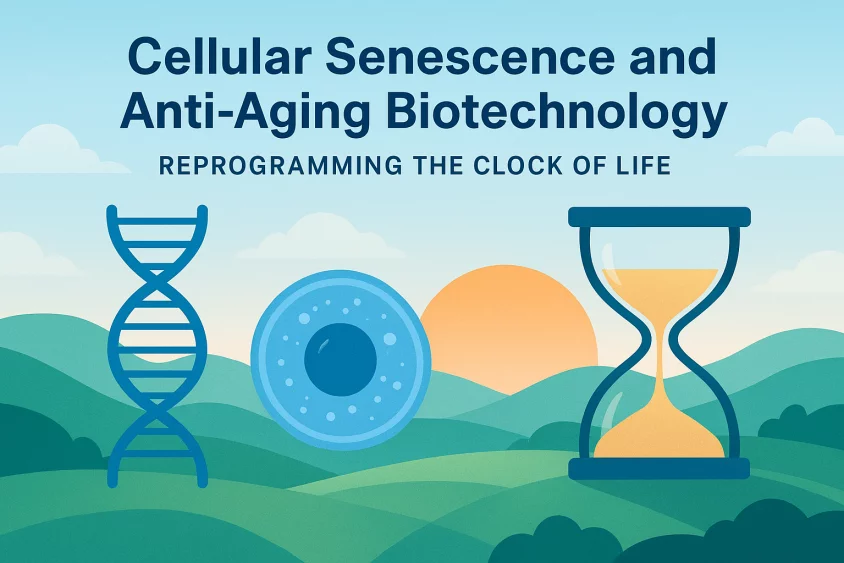
Cellular Senescence and Anti-Aging Biotechnology: Reprogramming the Clock of Life
1. Introduction: The Quest to Defy Aging
Aging is a natural biological process, yet it is also the primary risk factor for many chronic diseases, including cancer, diabetes, cardiovascular disease, and neurodegeneration. Scientists now see aging not as an inevitable decline, but as a process that can be understood, delayed, and potentially reversed.
At the heart of this paradigm shift is cellular senescence—a hallmark of aging and a key target for anti-aging biotechnology. In this course, we will explore the science of senescence, breakthroughs in biotechnology for rejuvenation, and how researchers are reprogramming biology itself to extend healthspan, not just lifespan.
2. What is Cellular Senescence?
Definition: Cellular senescence is a state in which cells permanently stop dividing but remain metabolically active.
Discovery: First observed by Leonard Hayflick in the 1960s (the Hayflick Limit) when cells were found to divide a limited number of times before entering a non-dividing state.
Triggers: Senescence can be induced by:
DNA damage
Telomere shortening (progressive loss of protective DNA ends during cell division)
Oxidative stress
Oncogene activation
While initially protective (preventing damaged cells from turning cancerous), senescent cells accumulate with age and secrete harmful molecules that disrupt tissue function.
3. The Senescence-Associated Secretory Phenotype (SASP)
Senescent cells release a cocktail of factors collectively known as SASP:
Cytokines (inflammatory molecules)
Proteases (enzymes breaking down tissue structure)
Growth factors (altering nearby cells’ behavior)
Impact of SASP
Promotes chronic inflammation ("inflammaging").
Impairs tissue regeneration.
Creates a microenvironment favorable to cancer.
Thus, while senescence is protective in youth, its persistence contributes to aging and age-related diseases.
4. Hallmarks of Aging and Senescence
Aging is driven by interconnected biological hallmarks, many of which overlap with senescence:
Genomic instability (DNA damage accumulation).
Telomere attrition (loss of chromosome caps).
Epigenetic alterations (changes in DNA packaging and gene expression).
Loss of proteostasis (protein misfolding, seen in Alzheimer’s).
Mitochondrial dysfunction (decline in energy production).
Stem cell exhaustion (reduced regenerative potential).
Cellular senescence (cells stuck in a non-dividing state).
5. Anti-Aging Biotechnology Approaches
5.1 Senolytics
Definition: Drugs that selectively eliminate senescent cells.
Examples:
Dasatinib + Quercetin (a drug + natural flavonoid combo shown to clear senescent cells in mice).
Navitoclax (ABT-263), a BCL-2 family inhibitor.
Potential: Improved cardiovascular function, reduced frailty, extended healthspan in animal studies.
5.2 Senomorphics
Definition: Compounds that suppress the harmful SASP secretions of senescent cells without killing them.
Examples:
Rapamycin: An mTOR inhibitor with anti-inflammatory and lifespan-extending properties.
Metformin: A diabetes drug under study for anti-aging effects.
5.3 Epigenetic Reprogramming
Concept: Reversing age-related changes by reprogramming cells back to a more youthful state.
Yamanaka Factors (OSKM: Oct4, Sox2, Klf4, c-Myc): A set of transcription factors that can revert adult cells to pluripotent stem cells.
Partial Reprogramming: Temporarily activating OSKM factors to rejuvenate cells without erasing their identity.
Applications: Reversal of tissue aging in mice, with ongoing research for humans.
5.4 Telomere Restoration
Background: Telomeres shorten each time a cell divides, eventually triggering senescence.
Therapies:
Telomerase activation (enzyme that lengthens telomeres).
Gene therapy approaches delivering telomerase to cells.
Challenges: Balancing rejuvenation while avoiding cancer risk, since telomerase is also active in tumors.
5.5 Stem Cell-Based Therapies
Induced Pluripotent Stem Cells (iPSCs): Rejuvenated cells that can be differentiated into fresh tissue.
Hematopoietic Stem Cell Transplants: Replacing aged immune systems with younger, more functional ones.
5.6 Mitochondrial Rejuvenation
Mitochondria are critical for cellular energy and signaling.
Approaches include:
Mitochondria-targeted antioxidants (e.g., MitoQ).
Gene therapies to repair mitochondrial DNA mutations.
NAD+ boosters (like nicotinamide riboside and NMN) to restore energy metabolism.
6. Case Studies and Current Progress
Unity Biotechnology: Clinical trials of senolytic drugs for osteoarthritis and eye diseases.
Calico Labs (Google-backed): Researching cellular reprogramming and longevity.
Altos Labs: Billion-dollar biotech focused on rejuvenation using partial reprogramming.
Animal Studies: Clearance of senescent cells in mice extends lifespan by 25–30% and improves organ function.
7. Ethical, Social, and Regulatory Considerations
Access and Equity: Will anti-aging biotech be available to all, or only the wealthy?
Safety: Ensuring that reprogramming does not increase cancer risk.
Philosophy: Should humans extend lifespan indefinitely? How will it impact society, resources, and ethics?
8. Future Directions
Combining senolytics with AI-driven drug discovery for faster identification of anti-aging molecules.
Exploring personalized longevity therapies based on genomic and epigenetic profiling.
Investigating aging clocks (like Horvath’s epigenetic clock) as biomarkers to track biological age and therapy success.
Long-term vision: not just treating age-related diseases, but redefining aging itself as a treatable condition.
9. Conclusion
Cellular senescence is no longer seen as an irreversible hallmark of aging but as a therapeutic target. Anti-aging biotechnology is opening possibilities to extend healthspan, restore youthful function, and reprogram the biological clock.
🌟 At BOLG, we bring these cutting-edge frontiers directly to you. Dive into the future of biotechnology, master the science of longevity, and unlock your potential to shape tomorrow’s medicine—today.