
🌐 Digital Cell Twins: Virtual Models for Predicting Disease, Drug Response, and Personalized Therapies
📖 Introduction: What Are Digital Cell Twins?
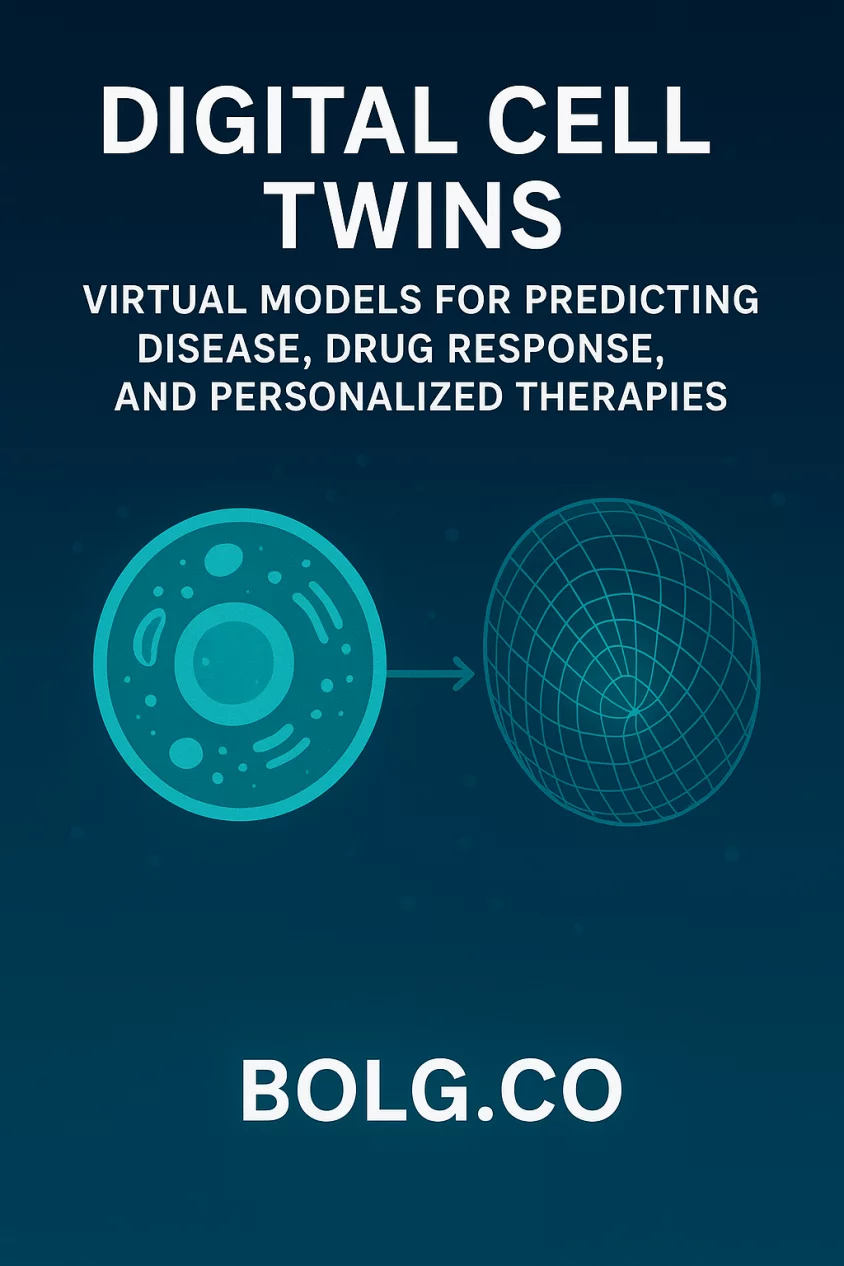
A Digital Cell Twin (DCT) is a high-fidelity virtual model of a living cell, designed to replicate its biological behaviors, molecular interactions, and responses to internal or external changes.
DCTs combine multiple scientific disciplines:
Systems Biology – understanding networks of genes, proteins, and pathways
Computational Modeling – simulating cellular functions using mathematical models
Machine Learning & AI – predicting changes based on real-world data
Bioinformatics – integrating genomics, transcriptomics, proteomics, and metabolomics
Biophysics – modeling energy flow, molecular motion, and cell mechanics
DCTs are emerging as a revolutionary tool in:
Drug discovery
Disease prediction
Toxicity testing
Personalized medicine
Biomanufacturing optimization
This course explains every concept step-by-step, enabling complete understanding without external guidance.
📘 Section 1: Foundations of Digital Cell Twin Technology
1.1 What Is a “Twin” in Biological Modeling?
A digital twin is a computer model that mirrors a real system.
When applied to cells, this requires:
Accurate biological data (DNA, RNA, protein, metabolite levels)
A computational architecture that simulates cell behavior
Continuous updating with experimental or clinical data
Goal:
To create a living digital prototype that behaves like a real cell.
1.2 Components of a Digital Cell Twin
A functional DCT typically includes:
1.2.1 Genomic Layer
Contains DNA sequence information and gene regulatory networks.
Explains which genes can be expressed and how they are controlled.
1.2.2 Transcriptomic Layer
Represents mRNA levels and expression dynamics.
Simulates how cells switch genes on/off in response to signals.
1.2.3 Proteomic Layer
Models protein synthesis, structure, function, and interactions.
Critical for understanding signaling and cellular decisions.
1.2.4 Metabolomic Layer
Simulates metabolic pathways, energy flow, and biosynthesis.
Essential for drug metabolism and toxicity predictions.
1.2.5 Signaling Pathways Layer
Represents networks of molecular signals that control cell behavior.
Allows simulation of cell cycle, apoptosis, immune activation, etc.
1.2.6 Biophysical Layer
Models:
molecular motion
reaction kinetics
membrane dynamics
mechanical stress
This makes DCTs capable of predicting realistic physical behavior.
📘 Section 2: Building a Digital Cell Twin—Step-by-Step
2.1 Data Collection
Creating a DCT begins with gathering multi-omics datasets:
Whole genome sequencing
RNA-seq transcriptome data
Proteomics (mass spectrometry)
Metabolite profiling
Imaging data (microscopy, cryo-EM)
Single-cell measurements
These datasets feed into computational models that reconstruct cellular processes.
2.2 Model Construction
2.2.1 Mathematical Modeling
DCTs use:
Ordinary differential equations (ODEs) to simulate dynamic processes
Stochastic models for random molecular events
Agent-based models for cell behavior
Constraint-based metabolic models (e.g., Flux Balance Analysis)
2.2.2 Machine Learning Integration
AI enhances DCT performance by:
predicting unknown reactions
filling gaps in biological pathways
optimizing model parameters
simulating drug responses
2.2.3 Feedback Loop Integration
Models continuously update using:
lab data
patient-specific data
environmental inputs
This keeps the twin accurate and personalized.
📘 Section 3: Applications of Digital Cell Twins
3.1 Predicting Drug Response
DCTs allow scientists to:
simulate drug–target interactions
predict therapeutic effects
estimate optimal dosing
identify off-target toxicity
This reduces reliance on animal testing and speeds up drug development.
3.2 Disease Modeling
Digital twins can mimic diseases such as:
cancer
diabetes
neurodegeneration
autoimmune disorders
By simulating mutations, metabolic shifts, or signaling dysregulation, a DCT can show how disease emerges and progresses at the molecular level.
3.3 Personalized Medicine
A DCT can be created using a patient's own data:
genomic sequence
blood transcriptome
metabolic profile
This enables:
predicting personalized treatment response
designing patient-specific drugs
minimizing side effects
choosing best therapy combinations
3.4 Toxicity Testing
Digital twins simulate:
chemical toxicity
organ-specific side effects
metabolic breakdown
immune activation
This is transforming safety evaluation in pharma and synthetic biology.
3.5 Biotechnology and Biomanufacturing
DCTs help optimize:
engineered cell lines
microbial factories
bioreactor performance
metabolic engineering strategies
They reduce trial-and-error and allow in silico optimization before real-world experiments.
📘 Section 4: Limitations and Future Directions
4.1 Current Challenges
limited multi-omics data availability
computational complexity
need for improved algorithms
incomplete knowledge of cell biology
4.2 Future Opportunities
full-organism digital twins
real-time clinical integration
AI-driven discovery of unknown pathways
personalized drug simulations for every patient
The field is evolving rapidly—DCTs will soon play a central role in medicine and biotechnology.
📘 Section 5: Glossary of Essential Terms (Fully Explained)
Digital Twin
A virtual model that accurately represents a physical system.
Omics
Large-scale biological datasets (genomics, proteomics, etc.).
ODE (Ordinary Differential Equation)
Mathematical equations describing how systems change over time.
Flux Balance Analysis
A computational method for predicting metabolic activity.
Agent-Based Model
Simulation where individual units (agents) follow rules that generate complex behavior.
Systems Biology
A holistic approach to understanding biological networks and interactions.
In Silico
Experiments performed via computer simulation.
📘 Final Thoughts
Understanding Digital Cell Twins empowers readers to explore the future of biotechnology, where virtual cells help solve real biological and medical challenges. This course gives you all the knowledge needed to grasp the science, technology, and application of DCTs without external instruction.
🌟 Closing Statement
Step into the future of predictive biology and precision medicine with BOLG—where innovation meets learning.
Explore, discover, and unlock your scientific potential with every course you take.