
🧫 Living Materials & Engineered Biointerfaces: Designing Responsive, Self-Healing Biological Systems
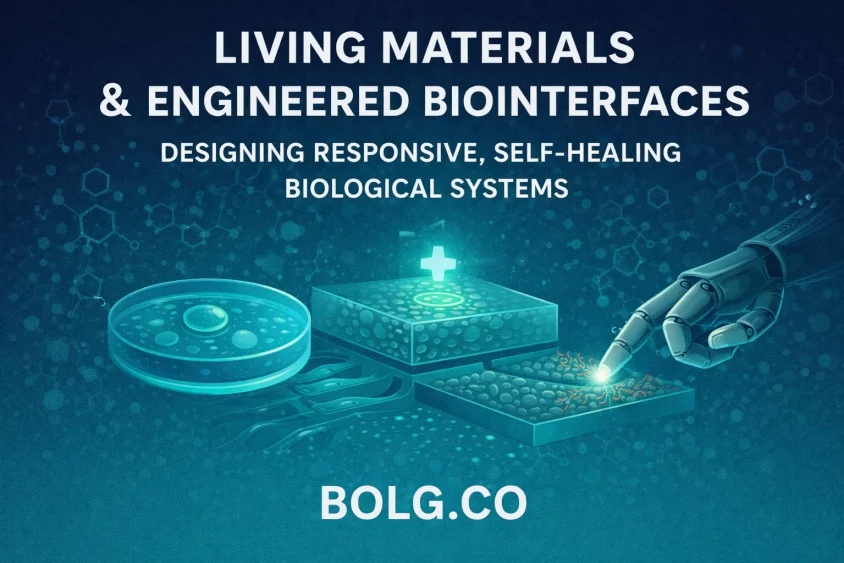
What if materials could sense, respond, adapt, and repair themselves—just like living organisms?
This vision is rapidly becoming reality through the emergence of living materials and engineered biointerfaces, a groundbreaking frontier at the intersection of biotechnology, materials science, and systems engineering.
Unlike traditional biomaterials, living materials incorporate active biological components—such as cells, enzymes, or genetically programmed organisms—that enable dynamic behavior. These systems are redefining how we design medical devices, regenerative therapies, smart surfaces, and even sustainable infrastructure.
What Are Living Materials?
Living materials are composite systems that integrate living cells or biological processes directly into material structures, enabling them to:
Respond to environmental stimuli
Self-heal after damage
Adapt functionality over time
Perform sensing, computation, or actuation
The biological component is not merely embedded—it is engineered to function as an active material element.
Key Biological Components
Genetically engineered bacteria or yeast
Mammalian cells for tissue-like functions
Cell-free biological systems
Protein-based or enzyme-driven networks
Engineered Biointerfaces: Bridging Biology and Technology
Engineered biointerfaces define how living systems interact with synthetic materials, electronics, or mechanical structures. These interfaces are critical for enabling communication between biological and non-biological components.
Core Design Principles
Biocompatibility and long-term stability
Controlled signal exchange (chemical, electrical, mechanical)
Spatial organization of cells and materials
Programmable biological responses
Biointerfaces allow materials to “listen” to biological signals and respond in a precise, predictable manner.
Functional Capabilities of Living Materials
🧬 Self-Healing Systems
Engineered cells can detect structural damage and initiate repair by:
Producing structural proteins
Secreting biominerals
Activating localized growth pathways
This capability has transformative implications for implants, coatings, and structural materials.
🔄 Stimulus-Responsive Behavior
Living materials can respond to:
Temperature changes
pH shifts
Mechanical stress
Chemical signals or toxins
This enables smart wound dressings, biosensors, and adaptive medical devices.
🧠 Embedded Biological Computation
Through synthetic gene circuits, living materials can:
Perform logical decision-making
Store biological memory
Trigger outputs only under specific conditions
This introduces computation directly into materials, blurring the line between hardware and biology.
Applications Transforming Biotechnology
🩺 Regenerative Medicine and Implants
Living materials enable:
Smart scaffolds for tissue regeneration
Implants that integrate seamlessly with host tissue
Adaptive surfaces that reduce inflammation or infection
These systems actively participate in healing rather than remaining passive.
🧪 Diagnostics and Biosensing
Biointerfaces allow materials to detect:
Pathogens
Metabolic biomarkers
Environmental toxins
Living sensors can continuously monitor biological conditions with unparalleled sensitivity.
🌱 Sustainable and Environmental Biotechnology
Living materials are being explored for:
Carbon-capturing building materials
Self-repairing infrastructure
Biodegradable smart materials
These innovations align biotechnology with global sustainability goals.
Challenges and Ethical Considerations
Despite their promise, living materials present challenges:
Controlling long-term biological behavior
Ensuring biosafety and containment
Regulatory classification of living systems
Ethical concerns around environmental release
Addressing these challenges requires robust design, interdisciplinary collaboration, and responsible innovation.
The Future: Programmable Matter Powered by Life
As advances in synthetic biology, biofabrication, and AI-guided design accelerate, living materials will evolve into fully programmable systems capable of learning, adapting, and coexisting with human environments.
The future points toward:
Smart medical devices that evolve with patients
Buildings that heal themselves
Biohybrid systems that redefine material intelligence
This is not just materials science—it is biology becoming infrastructure.
🚀 Shape the Future of Bioengineering with BOLG
At BOLG, we explore the technologies that redefine what is possible in modern biotechnology. From synthetic biology and biointerfaces to next-generation materials and systems design, our learning materials are built to empower scientists, innovators, and future leaders.
Dive into the frontier where biology becomes material with BOLG—expand your expertise, ignite innovation, and engineer the living systems of tomorrow.
👉 Explore more at bolg.co