
🧬 Organoids and Lab-Grown Tissues: Revolutionizing Disease Modeling and Drug Development
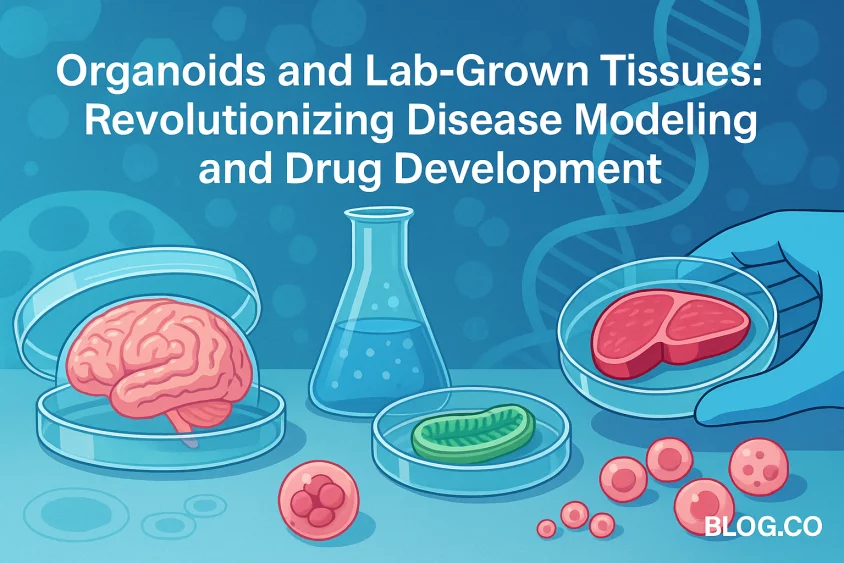
Biotechnology is advancing beyond test tubes and cell lines. In today’s biomedical frontier, organoids and lab-grown tissues are reshaping how we model diseases, test drugs, and envision future therapies. These 3D, miniaturized versions of human organs grown from stem cells are offering unprecedented physiological relevance, reducing the need for animal models and enabling personalized treatment strategies.
🔍 What Are Organoids?
Organoids are self-organizing, three-dimensional structures derived from pluripotent stem cells (PSCs) or adult stem cells. Under the right conditions, these cells differentiate into functionally and structurally relevant organ-like models, including mini-brains, livers, intestines, kidneys, and even retina.
Key Features:
3D structure that mimics real tissue architecture
Self-renewing and self-organizing stem cell-based models
Physiological function resembling human organs
Can be generated from patient-specific iPSCs for personalized studies
💊 Applications in Disease Modeling
Organoids have proven invaluable in modeling human diseases that were previously difficult to study in animals or 2D cell cultures.
Examples:
Cancer: Tumor-derived organoids (tumoroids) used for studying tumor microenvironment, mutation profiles, and drug resistance
Neurodevelopmental disorders: Brain organoids model conditions like microcephaly and autism
Infectious diseases: Used in Zika virus and SARS-CoV-2 research to understand pathogen-host interactions
With organoids, scientists can simulate individual patient biology, paving the way for precision medicine and personalized therapies.
🧫 Organoids in Drug Discovery and Testing
Traditional drug discovery relies on simplified cell models or animal testing, both of which often fail to accurately predict human responses. Organoids offer a more predictive and ethical alternative.
Key Advantages:
High-throughput drug screening in human-relevant models
Toxicology testing to predict adverse effects early
Identification of biomarkers and gene-drug interactions
Reduction in animal testing and associated costs
Pharmaceutical companies are increasingly integrating organoid platforms into preclinical drug pipelines, shortening time-to-market and improving success rates.
🧬 Future Horizons: Lab-Grown Tissues and Regenerative Medicine
Beyond modeling, lab-grown tissues from organoids are being explored for therapeutic transplantation. Though still in early phases, research is progressing in:
Liver bud transplantation for liver failure
Kidney tissue generation for renal disease
Retinal cell replacement for vision loss
Bioengineered skin grafts for burn victims
Integrating bioprinting, scaffold engineering, and vascularization techniques may one day allow us to recreate entire organs in the lab.
⚖️ Challenges and Ethical Considerations
Despite their promise, organoids raise several challenges:
Scalability and reproducibility in production
Incomplete maturity of tissues compared to adult organs
Ethical concerns about brain organoids and sentience
Regulatory uncertainty for clinical applications
Addressing these barriers will be crucial for translating organoid technology from bench to bedside.
🚀 Conclusion: The Next Frontier of Personalized Biomedicine
Organoids and lab-grown tissues are not just tools — they are gateways to a deeper understanding of human biology, more accurate therapies, and a less animal-dependent research paradigm. From pharmaceutical R&D to regenerative medicine, this technology is poised to become a foundational pillar in 21st-century biotechnology.
🔬 Ready to Explore the Future of Organoid Technology?
Dive into the future of biotechnology with BOLG. Whether you're a student, researcher, or industry professional, our expertly curated learning materials and advanced biotech courses will help you master emerging tools like organoids, 3D tissue engineering, and more.
👉 Start your journey today at www.bolg.co — where innovation meets education.