
🧬 Programmable Genome Integration: Next-Generation Tools for Writing Large DNA into Cells
Introduction: From Editing DNA to Writing Biological Programs
For more than a decade, genome editing has been transformed by technologies such as CRISPR-Cas systems. These tools have given scientists unprecedented control over DNA, allowing specific genetic sequences to be disrupted, corrected, or modified.
But a new question is emerging in biotechnology:
What if we could go beyond editing individual DNA letters and instead write entire genetic programs directly into the genome?
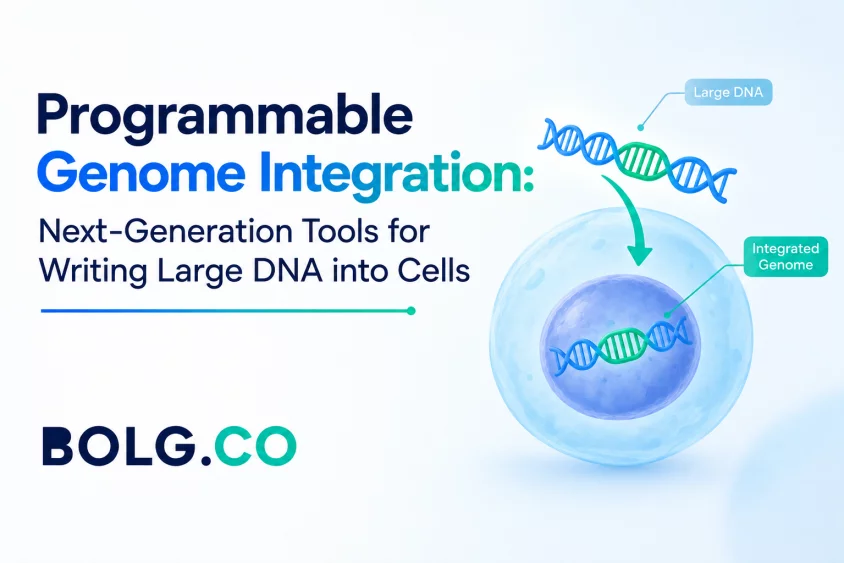
This concept is driving the rapid development of programmable genome integration—a new generation of technologies designed to insert large DNA sequences into predetermined locations within cells.
Traditional genome editing is often optimized for relatively small sequence changes. However, many therapeutic and biotechnology applications require much larger genetic payloads, including complete genes, regulatory elements, synthetic circuits, multi-gene pathways, and complex biological instructions.
Recent advances in programmable recombinases, retrotransposons, and CRISPR-associated transposases are opening new possibilities for precisely integrating kilobase-scale DNA into genomes. A September 2026 review in Nature Reviews Genetics highlighted these systems as an emerging route toward large-scale, mutation-agnostic genome engineering.
The field is therefore moving toward a powerful new paradigm:
Don't just edit the genome. Program what the genome can do.
1. What Is Programmable Genome Integration?
Programmable genome integration refers to technologies that enable researchers to insert designed DNA sequences into specific locations within a genome.
Instead of relying exclusively on traditional DNA cutting and repair mechanisms, researchers are engineering molecular systems that can recognize a genomic destination and integrate a DNA payload at that location.
The inserted sequence could potentially contain:
Functional genes
Therapeutic DNA
Regulatory sequences
Synthetic biological circuits
Multiple genes
Reporter systems
Enzyme pathways
Cellular programming instructions
Large genomic replacement sequences
This makes programmable integration fundamentally different from many conventional editing strategies.
Rather than asking:
"How can we change this DNA sequence?"
researchers can begin asking:
"What biological program do we want to install in this cell?"
2. Why Large DNA Insertion Is So Important
One of the biggest challenges in genome engineering is not necessarily changing DNA—it is adding large amounts of DNA accurately and safely.
Many diseases are genetically complex. Different patients may have different mutations that ultimately disrupt the same biological function.
A mutation-specific editing strategy may therefore require a separate intervention for every mutation.
Large-scale genome integration offers another possibility.
Instead of correcting each individual mutation, researchers could potentially introduce a functional genetic program that restores or bypasses the underlying defect.
This could support what is sometimes described as mutation-agnostic genome engineering.
For example, rather than designing a separate editor for dozens or hundreds of disease-associated variants, a future therapeutic strategy might install a functional genetic sequence capable of restoring biological activity across many variants.
This is one reason programmable insertion technologies are attracting significant attention.
3. The Limitations of Traditional Genome Editing
Conventional CRISPR genome editing frequently relies on creating a targeted DNA break followed by the cell's own repair machinery.
This approach has revolutionized genetic engineering, but it also introduces challenges.
DNA repair can produce:
Unwanted insertions or deletions
Rearrangements
Variable editing outcomes
Unintended genomic changes
Difficult-to-control integration patterns
Large DNA insertion can make these challenges even more complicated.
Researchers therefore began searching for alternative mechanisms capable of placing large DNA payloads into genomes without relying on conventional double-strand-break-based strategies.
This has created an expanding ecosystem of technologies based on molecular mechanisms that nature has already evolved for moving DNA.
4. Nature's Molecular Machinery Becomes a Biotechnology Toolkit
One of the most exciting aspects of programmable genome integration is that scientists are increasingly looking to natural genetic systems for inspiration.
Evolution has produced molecular machinery capable of moving genetic information between locations.
Researchers are now discovering, modifying, and engineering these systems for biotechnology.
Three particularly important technology families are:
4.1 Recombinases
Recombinases are enzymes capable of rearranging DNA by recognizing particular sequences and catalyzing recombination between them.
Engineered recombinases can potentially be used to insert large DNA sequences into predefined genomic locations.
Their ability to perform targeted DNA integration makes them attractive for applications where precision and cargo size are important.
4.2 Retrotransposons
Retrotransposons are naturally occurring genetic elements that can copy themselves through RNA intermediates.
Researchers are investigating whether their molecular mechanisms can be repurposed to enable programmable insertion of designed genetic sequences.
Recent work has explored engineered retrotransposon systems capable of targeted DNA insertion in mammalian cells, expanding the possibilities for RNA-templated genome engineering.
This represents an intriguing convergence of:
RNA biology + reverse transcription + genome engineering.
4.3 CRISPR-Associated Transposases
Perhaps one of the most fascinating developments is the combination of CRISPR targeting with transposase machinery.
CRISPR systems provide programmable targeting, while transposases naturally specialize in DNA movement.
The combination creates an appealing conceptual architecture:
CRISPR → Find the destination
Transposase → Move and insert the DNA
Researchers have demonstrated programmable DNA integration using CRISPR-associated transposase systems in human cells, providing an important foundation for future genome-writing technologies.
5. From CRISPR Editing to Genome Writing
The evolution of genome engineering can be viewed as a progression.
Generation 1: Genetic Modification
Early genetic engineering relied heavily on introducing genes into cells through relatively broad or less precisely controlled mechanisms.
Generation 2: Programmable Genome Editing
CRISPR and related technologies introduced programmable targeting, enabling researchers to modify specific genomic locations.
Generation 3: Precision DNA Writing
The emerging generation focuses on inserting increasingly large and sophisticated DNA sequences into predetermined genomic sites.
This represents a conceptual shift:
Editing → Rewriting → Programming
Instead of making isolated genetic changes, scientists are increasingly exploring ways to install complete biological functions.
6. How Large Can the Genetic Payload Become?
The ability to insert large DNA sequences is one of the most important technical objectives in this field.
Some emerging genome-integration platforms have demonstrated integration of DNA sequences ranging from several kilobases to substantially larger payloads.
For example, the PASTE platform demonstrated targeted integration of DNA sequences up to approximately 36 kilobases in human cell systems.
Other approaches—including engineered recombinases and retrotransposon-inspired systems—are being developed to expand the range, precision, and efficiency of genomic insertion.
The significance is enormous.
A larger payload could contain not just one gene, but potentially:
Gene + regulatory elements + control sequences + additional functional components
That creates opportunities for increasingly sophisticated genetic engineering.
7. Why This Could Transform Gene Therapy
The potential medical applications are particularly exciting.
Many current gene-therapy strategies focus on delivering a functional gene to cells.
Programmable genome integration could eventually provide a more controlled alternative by placing therapeutic DNA at a defined genomic location.
Potential applications include:
Inherited Genetic Disorders
Large DNA integration could potentially provide functional genetic sequences capable of addressing diseases caused by diverse mutations.
Blood Disorders
Engineered hematopoietic stem cells could potentially receive durable genetic programs designed to restore or modify cellular function.
Metabolic Diseases
Large genetic payloads could theoretically encode complex pathways rather than single proteins.
Rare Diseases
For genetically heterogeneous disorders, mutation-agnostic approaches could potentially simplify therapeutic development.
Cell Therapy
Engineered immune or regenerative cells could receive multiple genetic instructions that control their behavior.
8. Beyond Medicine: Engineering Cells as Biological Machines
Programmable genome integration could extend far beyond therapeutic applications.
Imagine a cell equipped with a carefully designed genetic program containing:
Sensors
Decision-making circuits
Therapeutic genes
Feedback mechanisms
Environmental response systems
Safety controls
Such a cell would not simply contain a new gene.
It could contain a programmable biological operating system.
This vision connects programmable genome integration with the broader fields of:
Synthetic biology
Cell engineering
Gene therapy
Biomanufacturing
Regenerative medicine
Precision medicine
The genome becomes more than an information archive.
It becomes an engineering platform.
9. Programmable Integration and Synthetic Biology
Synthetic biology aims to design biological systems with predictable and controllable functions.
One of its major challenges is integrating multiple genetic components into cells while maintaining stable and reliable behavior.
Programmable integration could provide a powerful solution.
Instead of introducing multiple genetic constructs randomly, future platforms could potentially install carefully organized biological circuits at predetermined genomic locations.
This could enable increasingly sophisticated cellular systems, including:
Biosensors
Therapeutic circuits
Metabolic pathways
Environmental-response systems
Programmable cellular factories
Engineered immune cells
The result could be a new generation of biological systems designed with the same principles used in engineering complex machines.
10. The Rise of Mutation-Agnostic Genome Engineering
One of the most important concepts associated with large-scale genome integration is mutation-agnostic engineering.
Traditional precision editing often begins with a specific mutation.
If hundreds of different mutations produce the same disease phenotype, each variant may require its own editing strategy.
Large DNA integration offers a fundamentally different approach.
A functional genetic program could potentially be inserted into an appropriate genomic location without requiring direct correction of every individual disease-causing mutation.
This could be particularly valuable for diseases characterized by extensive genetic heterogeneity.
The technology is still developing, but the conceptual shift is profound:
Instead of repairing every broken instruction, install a functional replacement program.
11. The Delivery Problem
Precision genome integration is only one part of the challenge.
A powerful genome-writing system is not useful if it cannot safely reach the appropriate cells.
Researchers therefore face another major engineering problem:
How do we deliver the molecular machinery and DNA payload to the right cells?
Potential delivery approaches include:
Viral vectors
Lipid nanoparticles
RNA-based systems
Protein delivery
Non-viral DNA delivery
Cell-based delivery strategies
Each approach has advantages and limitations involving:
Cargo capacity
Tissue targeting
Immunogenicity
Manufacturing
Stability
Cellular uptake
Safety
Recent research has specifically examined ways to make large-DNA integration more compatible with non-viral delivery strategies, illustrating how delivery and genome writing are becoming increasingly interconnected engineering problems.
12. Precision Is Not Optional
Writing DNA into the genome creates an important responsibility:
Where the DNA goes matters.
An integration system must ideally distinguish the intended genomic destination from similar sequences elsewhere in the genome.
Unwanted integration could potentially alter gene regulation or disrupt important genomic regions.
Therefore, next-generation genome-writing systems are being evaluated according to several critical parameters:
Targeting specificity
Can the system reliably recognize the intended genomic location?
Integration accuracy
Does the DNA enter in the correct orientation and configuration?
Cargo capacity
How much DNA can be integrated?
Efficiency
What proportion of target cells receive the desired modification?
Genomic stability
Does the inserted sequence remain stable over time?
Off-target activity
Does integration occur elsewhere in the genome?
These questions will become increasingly important as the technology moves toward therapeutic applications.
13. The Role of Artificial Intelligence
The future of genome writing will likely involve a powerful partnership between biological engineering and artificial intelligence.
AI can potentially assist researchers in:
Discovering new recombinases
Identifying novel transposases
Predicting enzyme activity
Designing genomic target sites
Optimizing protein sequences
Modeling DNA–protein interactions
Predicting off-target activity
Designing synthetic genetic circuits
The natural world contains enormous diversity in its genetic systems.
Computational approaches can help scientists search this biological diversity for molecular components with useful properties.
In this sense, AI could become a discovery engine for the next generation of genome-writing machinery.
14. Genome Mining: Searching Nature for Better Molecular Tools
One of the most exciting trends in modern biotechnology is the systematic exploration of biological diversity.
Researchers can examine enormous collections of genomic sequences to identify previously unknown enzymes and genetic systems.
This process—often called genome mining—can reveal molecular machinery with properties that are valuable for biotechnology.
Potentially useful characteristics include:
Higher specificity
Greater efficiency
Larger cargo capacity
Reduced toxicity
Different target-recognition mechanisms
Improved compatibility with mammalian cells
The result is a fascinating feedback loop:
Nature → Discovery → Engineering → Optimization → Biotechnology
The more genomes scientists explore, the larger the toolbox available for synthetic biology may become.
15. The Engineering Challenge: Making Systems Work in Human Cells
Many genome-integration mechanisms originate in microorganisms or mobile genetic elements.
But a molecular system that works effectively in bacteria may not automatically function inside a human cell.
Scientists must therefore solve numerous biological compatibility problems.
These include:
Protein expression
Nuclear localization
DNA accessibility
Cellular toxicity
Immune recognition
Target-site compatibility
DNA repair interactions
Payload delivery
This is why programmable genome integration is not simply a matter of discovering a new enzyme.
It is a multidisciplinary engineering challenge involving:
Molecular biology + protein engineering + genomics + synthetic biology + computational biology + delivery technology
16. Safety and Ethical Considerations
As the ability to write large genetic sequences improves, so does the importance of responsible biotechnology.
Researchers must carefully consider:
Genomic Safety
How can unintended genomic changes be detected and minimized?
Long-Term Stability
Will engineered genetic programs remain stable over many cell generations?
Immune Responses
Could the delivery system or molecular machinery trigger unwanted immune reactions?
Reversibility
Can an engineered genetic modification be controlled or reversed if necessary?
Germline Applications
Somatic therapeutic genome engineering and heritable genome modification raise very different ethical considerations.
Responsible Innovation
Greater genetic programmability requires strong standards for experimental validation, clinical safety, governance, and oversight.
The future of genome writing should therefore be shaped not only by what scientists can engineer, but also by what they can demonstrate to be safe, responsible, and beneficial.
17. What Could the Future Look Like?
Imagine a future in which a patient's cells are treated with a precisely engineered molecular system.
Instead of simply repairing a single mutation, the system could:
Identify the correct cellular population.
Locate a predetermined genomic address.
Deliver a large therapeutic DNA payload.
Integrate the sequence with high precision.
Activate the desired biological function.
Include regulatory elements that control its activity.
Potentially provide long-term therapeutic benefit.
This is still an emerging vision rather than routine clinical reality.
However, the scientific trajectory is becoming increasingly clear.
The field is moving toward programmable biological construction.
18. From Gene Editing to Cellular Programming
Perhaps the most important conceptual shift is that genome engineering is increasingly becoming a form of cellular programming.
A genome is not simply a static sequence of DNA.
It is an information-processing system capable of controlling:
Protein production
Cellular identity
Metabolism
Signaling
Environmental responses
Development
Repair
Communication
If scientists can reliably write large and functional DNA programs into specific genomic locations, they may eventually be able to engineer cells with increasingly sophisticated capabilities.
The long-term vision is not simply:
"Change the genome."
It is:
"Design what the cell is capable of becoming."
19. The Biotechnology Landscape Is Changing
Programmable genome integration sits at the intersection of several rapidly evolving technologies.
Technology Emerging Role
CRISPR Programmable genomic targeting
Recombinases Precise DNA integration
Transposases DNA mobilization and insertion
Retrotransposons RNA-templated DNA integration
Prime editing Precision sequence modification
Synthetic biology Design of biological programs
AI Molecular discovery and optimization
Nanoparticle delivery Transport of biological cargo
Cell engineering Creation of programmable therapeutic cells
Together, these technologies are creating something much larger than a collection of genome-editing tools.
They are contributing to the emergence of a programmable biological engineering ecosystem.
20. Challenges That Must Be Solved
Despite remarkable progress, programmable genome integration remains an emerging field.
Several challenges must be addressed before widespread therapeutic implementation becomes possible.
Efficiency
Integration must occur efficiently in the desired cell population.
Specificity
The system must minimize unintended genomic insertion.
Payload Size
Larger DNA cargos create additional challenges for delivery and integration.
Delivery
Molecular machinery must reach the correct tissues and cells.
Manufacturing
Complex biological systems must eventually be manufactured consistently and at scale.
Safety
Long-term genomic consequences must be carefully evaluated.
Regulation
Regulatory frameworks will need to evolve alongside increasingly sophisticated genome-engineering technologies.
Solving these problems will require collaboration across biotechnology disciplines.
21. Why Programmable Genome Integration Matters for the Future of Biotechnology
Programmable genome integration represents more than another improvement in gene editing.
It represents a change in the scale of genetic engineering.
Traditional genome editing often focuses on individual bases, mutations, or relatively small sequence changes.
The emerging genome-writing paradigm focuses increasingly on large genetic programs.
This could ultimately enable scientists to think about biological engineering at multiple scales:
Base → Gene → Pathway → Circuit → Cellular Program
Such scalability could reshape therapeutic development, synthetic biology, regenerative medicine, agriculture, biomanufacturing, and basic biological research.
Conclusion: The Era of Writing Biology Is Beginning
The history of biotechnology has always been a story of increasing control over biological information.
We learned to read DNA.
Then we learned to edit DNA.
Now, biotechnology is moving toward a far more ambitious goal:
Writing biological programs directly into living cells.
Programmable recombinases, retrotransposons, CRISPR-associated transposases, and related genome-integration systems are helping researchers explore how large DNA sequences can be installed with increasing precision. Recent research suggests that these technologies could eventually overcome some of the limitations associated with conventional genome editing and open new possibilities for mutation-agnostic genetic engineering.
The ultimate promise is extraordinary.
A future where scientists do not simply correct individual genetic errors—but design, install, and control biological functions.
A future where the genome becomes an engineering platform.
A future where cells can be programmed to perform entirely new tasks.
And perhaps most importantly, a future where the boundaries between genomics, synthetic biology, AI, medicine, and engineering become increasingly blurred.
🚀 Explore the Future of Biotechnology with BOLG
The biotechnology revolution is no longer limited to understanding how life works—it is increasingly about learning how to engineer what life can do.
At BOLG, we believe that understanding tomorrow's biotechnology starts with learning today's most powerful concepts.
From genome engineering and synthetic biology to CRISPR, bioinformatics, molecular biology, AI-driven biotechnology, and next-generation therapeutic technologies, BOLG is designed to help learners transform complex scientific ideas into practical knowledge and future-ready expertise.
Don't just watch the biotechnology revolution happen. Understand it. Explore it. Master it.
🧬 Dive deeper into the world of biotechnology with BOLG—and unlock the knowledge to help shape the biological technologies of tomorrow.