
🧬 Proteome Engineering & Programmable Protein Degradation: Controlling Cellular Machinery in Real Time
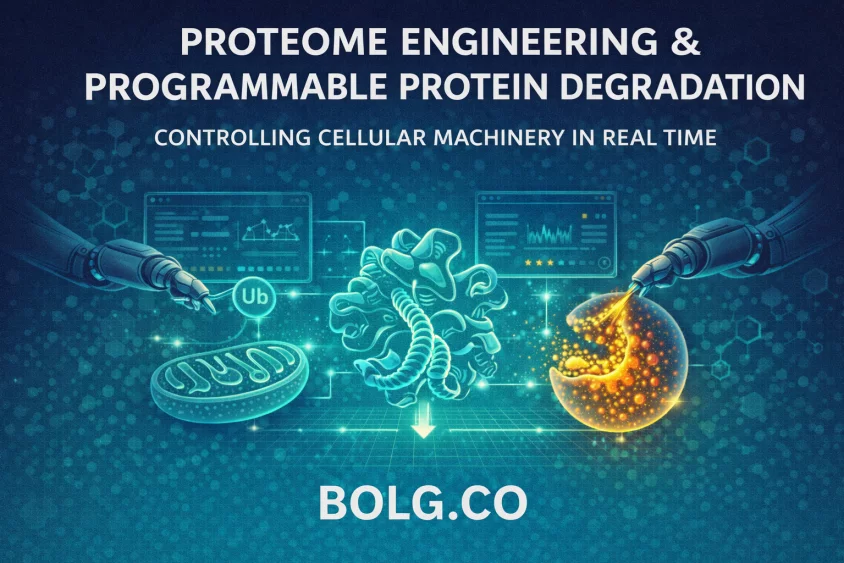
Proteins are the functional engines of life. While traditional biotechnology has focused on editing DNA or regulating RNA, modern advances now enable direct control of proteins themselves — their stability, localization, activity, and degradation.
This course explores proteome engineering, an emerging frontier that allows scientists to manipulate protein life cycles in real time. You will learn how targeted protein degradation systems, synthetic degrons, and proteostasis engineering are transforming medicine, biotechnology, and drug discovery.
This course is fully self-guided and self-contained. Every concept is defined clearly, every mechanism explained step-by-step, ensuring complete independent learning.
Section 1: Foundations of the Proteome
1.1 What Is the Proteome?
The proteome refers to the complete set of proteins expressed by a cell, tissue, or organism at a given time.
Unlike the genome, which is relatively stable, the proteome is:
Dynamic
Context-dependent
Rapidly regulated
Sensitive to environmental signals
Protein levels determine cellular function, behavior, and fate.
1.2 Protein Life Cycle
Every protein undergoes a regulated life cycle:
Gene transcription
mRNA translation
Folding and modification
Functional activity
Degradation
Proteome engineering focuses particularly on steps 4 and 5, especially controlled degradation.
Section 2: The Ubiquitin–Proteasome System (UPS)
2.1 What Is Ubiquitination?
Ubiquitination is a process in which a small protein called ubiquitin is attached to a target protein, marking it for degradation.
This involves three enzyme classes:
E1 (activating enzyme)
E2 (conjugating enzyme)
E3 (ligase enzyme — provides target specificity)
E3 ligases are critical for selective protein targeting.
2.2 The Proteasome
The proteasome is a large protein complex responsible for degrading ubiquitinated proteins into peptides.
It ensures:
Removal of damaged proteins
Regulation of signaling proteins
Control of cell cycle progression
Maintenance of protein quality control
This system is central to proteostasis.
Section 3: Targeted Protein Degradation Technologies
3.1 PROTACs (Proteolysis Targeting Chimeras)
PROTACs are bifunctional molecules that:
Bind a target protein
Recruit an E3 ligase
Induce ubiquitination
Trigger degradation
Unlike inhibitors, PROTACs eliminate proteins entirely rather than merely blocking them.
3.2 Molecular Glues
Molecular glues are small molecules that:
Promote interaction between a protein and an E3 ligase
Trigger selective degradation
They are simpler than PROTACs but equally transformative in drug design.
3.3 Lysosome-Targeting Strategies
Not all proteins are degraded via proteasomes. Alternative pathways include:
Autophagy-mediated degradation
Lysosome-targeting chimeras (LYTACs)
Endosomal routing systems
These strategies allow degradation of membrane and extracellular proteins.
Section 4: Synthetic Degrons and Inducible Systems
4.1 What Is a Degron?
A degron is a sequence motif within a protein that signals degradation.
Scientists can:
Engineer synthetic degrons
Add conditional degrons
Control degradation with light or small molecules
4.2 Inducible Degradation Systems
Examples include:
Auxin-inducible degron systems
Light-activated degradation
Drug-responsive degradation tags
These enable temporal precision, allowing researchers to control protein stability in real time.
Section 5: Applications in Medicine
5.1 Cancer Therapy
Targeted protein degradation can eliminate:
Oncogenic transcription factors
Mutant signaling proteins
Drug-resistant targets
This approach expands the “druggable” proteome.
5.2 Neurodegenerative Diseases
By degrading:
Aggregated proteins
Misfolded proteins
Toxic peptides
Proteome engineering may address diseases such as Alzheimer’s and Parkinson’s.
5.3 Precision and Personalized Medicine
Proteome manipulation enables:
Patient-specific protein targeting
Adaptive therapeutic responses
Reduced off-target toxicity
Section 6: Proteostasis and Cellular Homeostasis
6.1 What Is Proteostasis?
Proteostasis refers to the balance between:
Protein synthesis
Folding
Trafficking
Degradation
Disruption leads to disease.
6.2 Engineering Proteostasis Networks
Biotechnology now aims to:
Enhance protein quality control
Stabilize beneficial proteins
Remove pathogenic proteins
Rewire cellular stability networks
Section 7: Advantages and Challenges
Advantages
Targets previously “undruggable” proteins
Reduces need for continuous inhibition
High specificity potential
Reversible and tunable
Challenges
Off-target degradation
Delivery to specific tissues
Long-term safety considerations
Resistance mechanisms
Section 8: Future Directions
AI-guided degrader design
Proteome-wide programmable control
Integration with synthetic gene circuits
Combination with digital cell models
Smart, condition-responsive degraders
Proteome engineering represents a paradigm shift from static inhibition to dynamic cellular control.
Glossary
Proteome: Complete set of proteins in a cell
Ubiquitin: Small protein tag marking proteins for degradation
E3 Ligase: Enzyme providing target specificity
Proteasome: Complex that degrades ubiquitinated proteins
PROTAC: Molecule inducing targeted protein degradation
Proteostasis: Protein homeostasis balance
Closing Statement
Move beyond genes. Go beyond transcripts. Master the functional machinery of life itself.
With BOLG, you don’t just learn biotechnology — you gain command over the molecular systems that power living cells.
Step into the era of programmable proteomes and redefine what’s possible in precision medicine and next-generation therapeutics.