
🔬 Single-Cell Multi-Omics Integration: Decoding Cellular Heterogeneity for Precision Medicine
📖 Introduction: A New Era of Cellular Resolution
Biology is no longer studied in averages. Traditional bulk analysis has long masked the complexity of biological systems by blending signals from millions of cells. Today, single-cell technologies are revolutionizing our understanding of life at its most fundamental level.
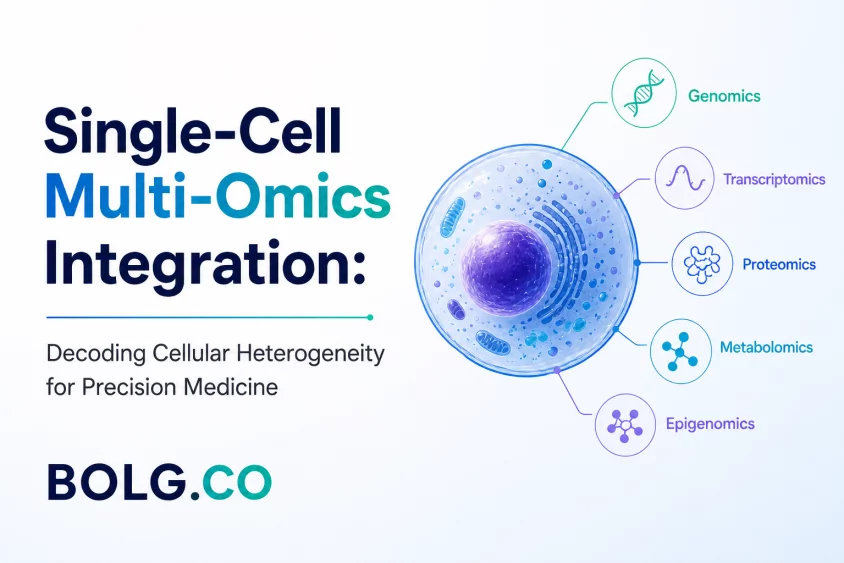
At the forefront of this revolution lies single-cell multi-omics integration—a transformative approach that simultaneously captures and integrates multiple layers of biological information from individual cells. By combining genomics, transcriptomics, epigenomics, and proteomics, scientists can now construct high-resolution cellular maps that redefine disease understanding and therapeutic innovation.
🧬 What is Single-Cell Multi-Omics Integration?
Single-cell multi-omics refers to the simultaneous measurement and computational integration of multiple molecular modalities within the same cell or across matched cellular populations.
Key Omics Layers:
Genomics – DNA sequence and mutations
Transcriptomics – RNA expression profiles
Epigenomics – Chromatin accessibility and DNA methylation
Proteomics – Protein abundance and signaling states
The integration of these layers provides a holistic, systems-level view of cellular identity and function, enabling researchers to uncover hidden biological patterns that were previously inaccessible.
⚙️ Core Technologies Driving the Field
1. Single-Cell RNA Sequencing (scRNA-seq)
Captures gene expression at single-cell resolution, forming the backbone of many multi-omics studies.
2. ATAC-seq and Epigenetic Profiling
Measures chromatin accessibility, revealing regulatory elements that control gene expression.
3. CITE-seq and REAP-seq
Combine transcriptomics with protein-level data using antibody-based tagging.
4. Multi-Modal Platforms
Advanced platforms like 10x Genomics Multiome allow simultaneous profiling of RNA and chromatin accessibility in the same cell.
5. Computational Integration Tools
Machine learning and AI-driven frameworks (e.g., Seurat, Scanpy, MOFA+) enable:
Data alignment across modalities
Batch correction
Cellular trajectory inference
Network reconstruction
🔍 Why Integration Matters: Beyond Single-Layer Biology
Single-modality analysis provides only a partial view. Multi-omics integration enables:
Decoding Cellular Heterogeneity
Identify rare cell populations and transitional states.Linking Genotype to Phenotype
Connect genetic mutations to functional cellular outcomes.Understanding Regulatory Networks
Reveal how epigenetic changes drive gene expression programs.Improving Data Accuracy
Cross-validation across modalities enhances biological confidence.
🧪 Applications in Biotechnology and Medicine
1. Cancer Research
Dissect tumor heterogeneity at unprecedented resolution
Identify drug-resistant subpopulations
Map tumor microenvironments
2. Immunology and Immunotherapy
Profile immune cell diversity and activation states
Optimize CAR-T and CAR-NK therapies
Discover biomarkers for treatment response
3. Developmental Biology
Trace cell lineage trajectories
Understand differentiation pathways
Model embryonic development
4. Precision Medicine
Enable patient-specific disease profiling
Guide targeted therapeutic strategies
Predict drug responses at the cellular level
5. Neurological Disorders
Map neuronal subtypes and circuits
Investigate molecular drivers of neurodegeneration
Identify early disease signatures
🧠 The Role of AI and Machine Learning
The complexity of multi-omics datasets requires advanced computational intelligence. AI is playing a pivotal role in:
Integrating heterogeneous datasets
Identifying hidden cellular states
Predicting gene regulatory interactions
Building digital cellular models
Deep learning models are increasingly used to simulate how cells respond to perturbations, bringing us closer to predictive and programmable biology.
⚠️ Challenges and Limitations
Despite its promise, the field faces several challenges:
Data Complexity – High-dimensional datasets require robust computational pipelines
Cost and Scalability – Multi-omics experiments remain resource-intensive
Standardization Issues – Lack of universal protocols
Data Integration Biases – Variability across platforms and experiments
Addressing these challenges will be critical for translating discoveries into real-world applications.
🚀 Future Directions: Toward a Cellular Atlas of Life
The future of single-cell multi-omics is incredibly promising:
Integration with Spatial Biology
Linking molecular data with spatial context in tissuesReal-Time Cellular Monitoring
Dynamic tracking of cellular states over timeClinical Translation
Routine use in diagnostics and personalized therapyDigital Cell Twins
Creating computational replicas of cells for predictive modelingGlobal Human Cell Atlas Initiatives
Mapping every cell type in the human body
These advances will ultimately enable a new paradigm of precision medicine, where treatments are tailored at the level of individual cells.
🌟 Conclusion: Unlocking the Full Complexity of Life
Single-cell multi-omics integration represents one of the most powerful tools in modern biotechnology. By capturing the intricate interplay between genes, proteins, and regulatory mechanisms within individual cells, it is reshaping our understanding of biology and disease.
From uncovering hidden cellular diversity to enabling next-generation therapeutics, this field stands at the intersection of biology, technology, and data science—driving innovation across the life sciences.
🚀 Step Into the Future with BOLG
Unlock the power of next-generation biotechnology with BOLG—your gateway to mastering cutting-edge fields like single-cell analysis, multi-omics integration, and computational biology.
Explore advanced learning materials, hands-on courses, and expert-driven insights designed to transform your knowledge into real-world impact. Whether you're aiming to lead breakthroughs in research or accelerate your biotech career, BOLG equips you with the tools to thrive in the era of precision medicine.
Step beyond the basics. Decode life at its deepest level. Build the future of biotechnology with BOLG.