
🧠 Synthetic Biology: Designing Life with Bioengineering
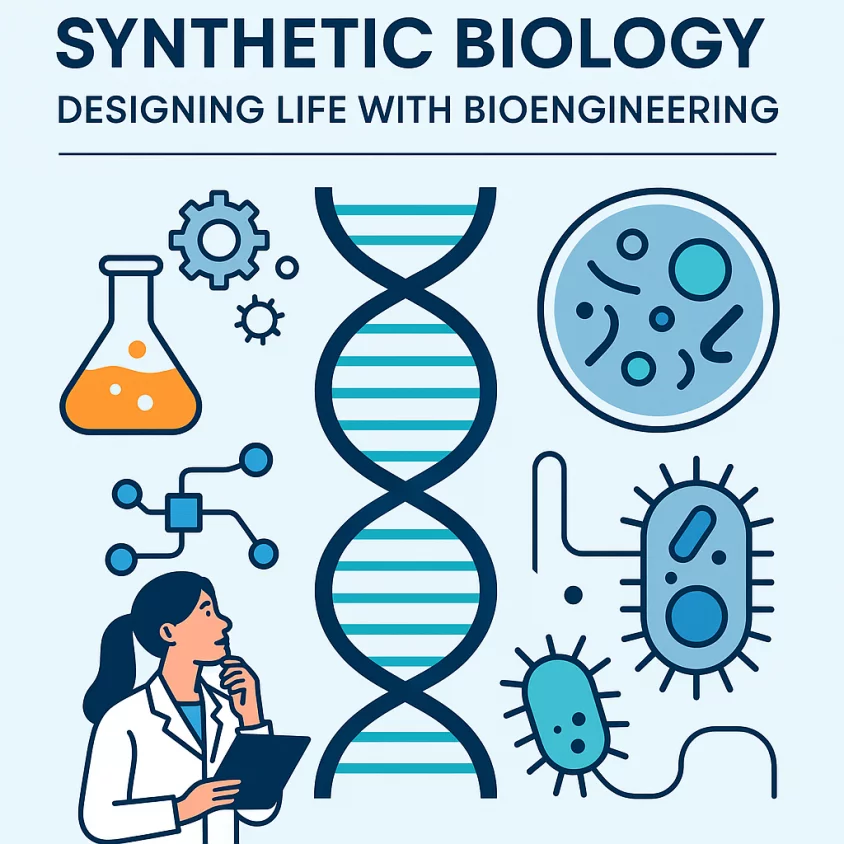
Synthetic Biology is an interdisciplinary scientific field that combines biology, engineering, computer science, and chemistry to design, construct, and engineer new biological systems, components, and organisms. It takes the tools of genetic engineering to the next level—creating biological functions that don’t exist in nature, enabling us to solve critical challenges in health, environment, and technology.
This course is designed to be self-sufficient and detailed, ensuring learners gain a thorough understanding independently. Each term is defined, concepts are explained, and applications are illustrated with clear examples.
📘 Course Outline
1. Foundation & Definitions
1.1 What is Synthetic Biology?
Definition: Engineering biology by constructing new DNA, genetic circuits, and systems not found in nature.
Distinct from traditional genetic engineering, which typically modifies existing genes rather than building entirely new systems.
Core Design Principles:
Modularity: Treating genetic parts like interchangeable modules.
Standardization: Using uniform formats to assemble parts.
Abstraction: Hiding complexity by using higher-level design tools.
1.2 Historical Perspective
Origins in recombinant DNA technology—the ability to cut and paste DNA.
Progression to rational design, where DNA is engineered to behave predictably.
Evolution into today’s synthetic biology, integrating engineering principles.
2. Genetic Parts × BioBricks
2.1 What are BioBricks?
BioBricks: Standardized, well-characterized DNA sequences representing genetic functions (e.g., promoters, coding regions).
Promoter: A DNA region where gene expression begins.
Ribosome Binding Site (RBS): A sequence that initiates protein synthesis.
Terminators: DNA ends that halt gene transcription.
2.2 Genetic Circuit Examples
Logic Gates (AND, OR, NOT): Devices built from genetic parts that respond to molecular inputs.
Toggle Switches: Circuits that remain in one of two stable states.
Oscillators: Systems that fluctuate, like a biological clock.
2.3 Synthetic Organisms
Example: Mycoplasma mycoides JCVI-syn3.0—a genome reduced to only essential genes, a landmark in minimal biosystems.
3. DNA Assembly & Editing Tools
3.1 Assembling DNA
Gibson Assembly: A method that joins multiple DNA fragments with overlapping ends using enzymes.
Golden Gate Cloning: Uses Type IIS restriction enzymes to assemble parts in one step.
BioBrick Cloning: Uses specific restriction sites to combine standardized parts.
3.2 CRISPR in Synthetic Biology
CRISPR (Clustered Regularly Interspaced Short Palindromic Repeats): A system used to edit genomes precisely.
Cas9: An enzyme that cuts DNA at a specific target.
Utilized for genome rewriting and building gene drives—self-spreading genetic traits.
3.3 Computational Modeling Tools
Benchling, Geneious, SnapGene: Platforms to design DNA circuits, simulate genetic systems, and visualize constructs.
4. Applications Across Fields
4.1 Medicine & Healthcare
Engineering bacteria to produce insulin, vaccines, and anticancer molecules.
Developing biosensors (e.g., toehold switches) that detect disease markers.
Personalized medicine powered by on-demand drug synthesis.
4.2 Environmental Solutions
Bioremediation: Genetically engineered microbes to detoxify pollutants.
Carbon capture through bioengineered photosynthetic systems.
Synthetic solutions for plastic degradation.
4.3 Food & Agriculture
Engineering crops for:
Nitrogen fixation—reducing fertilizer usage.
Precision fermentation—creating proteins like egg whites without animals.
Disease and pest resistance through synthetic circuits.
4.4 Industrial Biotechnology
Designer microbes for biofuel generation.
Bioplastic synthesis and creation of living materials and self-healing biomaterials.
5. Emerging Frontiers
5.1 Artificial Cells & Xenobiology
Artificial cells: Laboratory-built cell-like structures.
Xenobiology: Designing life forms that use novel, non-natural DNA chemistries.
5.2 Minimal Genomes & Orthogonal Life
Creating organisms containing only essential genes.
Orthogonal life: Systems built using different nucleic acid units that don’t interact with natural biology—safer and more controllable.
5.3 Space Synthetic Biology
Engineering organisms for life support and resource use in space and on Mars—food, oxygen, and recycling.
6. Ethics, Safety, and Governance
6.1 Biosafety & Biosecurity
Protecting humans and ecosystems from unintended releases.
Preventing dual-use (misuse for harmful purposes).
6.2 Intellectual Property & Open-Source Biology
Patenting biological parts vs. sharing openly via tools like the iGEM Registry of Standard Biological Parts.
6.3 Public Engagement & Regulation
Explaining synthetic biology to the public.
Creating clear guidelines for research and application.
7. Real-World Case Studies
7.1 iGEM Competition
Annual global student competition to build synthetic biology projects solving real-world problems.
7.2 Leading Synthetic Biology Companies
Profiles of Ginkgo Bioworks, Zymergen, Synthego, which are revolutionizing biotech with engineered biology.
📌 Conclusion
Synthetic Biology represents the next leap in engineering biology—building life from the bottom up. You’ve learned how modular DNA parts combine into circuits, tools like CRISPR and computational models support design, and real-world applications solve real-world problems—all independently and comprehensively.
🚀 Final Statement
Engineer biology and shape tomorrow’s innovations with BOLG. Our expertly curated materials empower you to master synthetic biology from fundamentals to applications—no additional instruction required. Explore, Design, Innovate—with BOLG.