
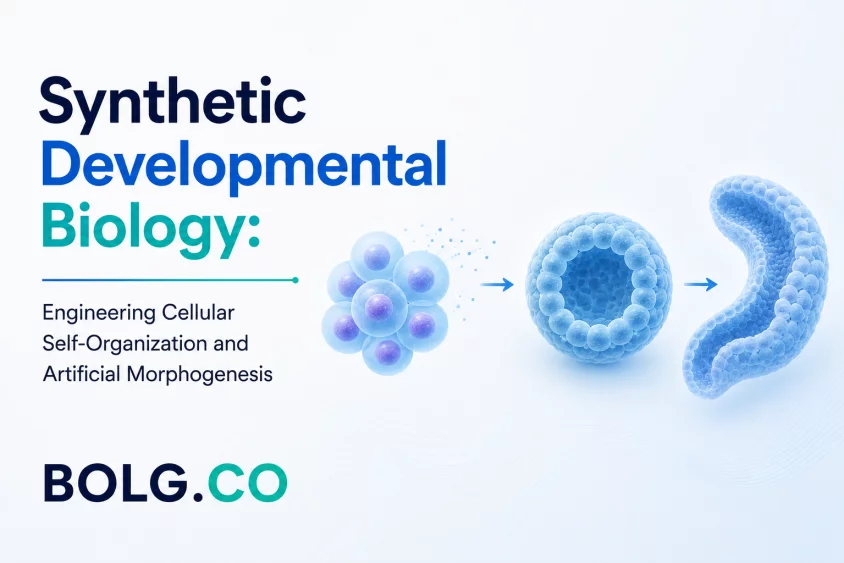
Synthetic Developmental Biology: Engineering Cellular Self-Organization and Artificial Morphogenesis
Course Overview
Synthetic Developmental Biology is an emerging interdisciplinary field that combines developmental biology, synthetic biology, systems biology, stem cell engineering, and bioengineering to understand and program how living systems build themselves. Rather than simply modifying individual genes, researchers aim to engineer entire developmental processes, enabling cells to self-organize into tissues, organ-like structures, and potentially fully functional biological systems.
This course explores the fundamental principles of development, the mechanisms that drive cellular self-organization, the engineering tools used to control developmental programs, and the future applications of artificial morphogenesis in biotechnology and regenerative medicine.
Learning Objectives
By the end of this course, learners will be able to:
Explain the fundamental principles of developmental biology.
Understand how cells communicate and coordinate during development.
Describe self-organization and emergent biological behavior.
Understand the concept of morphogenesis and tissue pattern formation.
Explain how synthetic biology can be used to engineer developmental systems.
Identify the role of stem cells, organoids, and synthetic embryology.
Explore applications of synthetic developmental biology in medicine and biotechnology.
Recognize the ethical and regulatory considerations associated with developmental engineering.
Module 1: Foundations of Development and Self-Organization
What is Developmental Biology?
Developmental biology studies how a single fertilized cell transforms into a complex multicellular organism. Through a series of coordinated events, cells divide, specialize, communicate, and organize into tissues and organs.
Development involves several major processes:
Cell proliferation
Cellular differentiation
Pattern formation
Morphogenesis
Organ development
These processes are controlled through highly regulated genetic and molecular programs.
Cellular Differentiation
Although most cells contain the same DNA, different genes are activated in different cell types. This selective gene expression allows cells to become:
Neurons
Muscle cells
Liver cells
Skin cells
Immune cells
Differentiation is controlled by transcription factors, signaling pathways, and epigenetic modifications.
Self-Organization in Biology
One of the most remarkable features of living systems is self-organization.
Self-organization refers to the spontaneous formation of ordered structures through local interactions among cells without the need for a central controller.
Examples include:
Embryonic development
Neural network formation
Blood vessel growth
Tissue regeneration
Simple cellular behaviors can collectively generate highly complex biological structures.
Emergent Properties
An emergent property is a characteristic that arises from interactions among many components.
Examples include:
Consciousness emerging from neurons
Heart function emerging from cardiac cells
Tissue architecture emerging from cellular interactions
Synthetic developmental biology seeks to harness these emergent behaviors for engineering purposes.
Module 2: Cellular Communication and Morphogenesis
Cellular Signaling
Cells constantly exchange information through signaling molecules.
Major signaling mechanisms include:
Paracrine Signaling
Signals affect nearby cells.
Autocrine Signaling
Cells respond to signals they produce themselves.
Juxtacrine Signaling
Communication occurs through direct cell-to-cell contact.
Endocrine Signaling
Hormones travel long distances through circulation.
These signaling systems coordinate development across tissues.
Morphogens and Pattern Formation
Morphogens are signaling molecules that form concentration gradients across developing tissues.
Cells interpret morphogen concentrations to determine their developmental fate.
Morphogen gradients help establish:
Body axes
Tissue boundaries
Organ positioning
Cellular specialization
Key Developmental Pathways
Several highly conserved signaling pathways regulate development:
Wnt Pathway
Controls cell proliferation and body patterning.
Notch Pathway
Regulates cell fate decisions and tissue organization.
Hedgehog Pathway
Guides embryonic pattern formation and organ development.
BMP/TGF-β Pathway
Controls differentiation and tissue specification.
Together, these pathways coordinate developmental processes throughout life.
Morphogenesis
Morphogenesis is the process through which tissues and organs acquire shape.
Important mechanisms include:
Cell migration
Cell adhesion
Cytoskeletal remodeling
Programmed cell death
Mechanical force generation
Morphogenesis transforms groups of cells into functional biological structures.
Module 3: Engineering Developmental Programs
Synthetic Biology and Development
Synthetic biology applies engineering principles to biological systems.
In synthetic developmental biology, researchers design genetic programs that influence:
Cellular behavior
Differentiation
Communication
Tissue organization
The goal is to create predictable developmental outcomes.
Synthetic Gene Circuits
Gene circuits are engineered genetic systems that function similarly to electronic circuits.
Components include:
Sensors
Regulatory elements
Output genes
These circuits can perform biological computations and control developmental decisions.
Programming Cell Fate
Scientists can direct cellular differentiation by introducing specific developmental signals or transcription factors.
Examples include converting adult cells into:
Neurons
Heart cells
Stem cells
Pancreatic cells
This capability has major implications for regenerative medicine.
Engineering Cell Communication
Researchers can create synthetic communication systems using engineered receptors and signaling molecules.
These systems allow groups of cells to coordinate behavior and form organized structures.
Artificial Morphogenesis
Artificial morphogenesis refers to the deliberate engineering of biological shape formation.
Scientists design developmental rules that guide cells to:
Organize spatially
Form patterns
Construct tissue-like structures
Generate functional architectures
This represents one of the most ambitious goals of modern biotechnology.
Module 4: Synthetic Embryology, Applications, and Future Directions
Synthetic Embryology
Synthetic embryology seeks to recreate aspects of embryonic development using stem cells and engineered biological systems.
Researchers develop embryo-like structures that mimic early developmental events, allowing detailed study of developmental mechanisms.
Organoids
Organoids are miniature three-dimensional tissue models derived from stem cells.
Examples include:
Brain organoids
Liver organoids
Kidney organoids
Intestinal organoids
Retinal organoids
Organoids reproduce many structural and functional features of real organs.
Applications in Regenerative Medicine
Synthetic developmental biology offers promising approaches for:
Tissue regeneration
Organ replacement
Personalized medicine
Disease modeling
Drug discovery
Patient-derived stem cells may eventually be used to generate customized tissues and organs.
Computational Developmental Engineering
Computer modeling plays an increasingly important role in developmental design.
Researchers use simulations to predict:
Tissue growth
Cellular interactions
Pattern formation
Morphological outcomes
Artificial intelligence is further accelerating the design of developmental systems.
Ethical and Regulatory Considerations
As developmental engineering advances, important questions arise regarding:
Synthetic embryo models
Human tissue engineering
Biosafety
Biosecurity
Regulatory oversight
Responsible innovation is essential to ensure safe and ethical implementation of these technologies.
Future Perspectives
Future developments may include:
Programmable living tissues
Synthetic organs
Self-healing biological materials
Advanced regenerative therapies
Developmentally engineered biological systems
As our understanding of developmental programming grows, biology may increasingly become a designable engineering platform.
Course Summary
Synthetic Developmental Biology combines developmental biology and synthetic biology to engineer how living systems organize, grow, and form complex structures. By understanding cellular communication, self-organization, morphogenesis, and developmental signaling, scientists are beginning to design biological systems capable of forming tissues and organ-like structures autonomously.
Advances in synthetic embryology, organoid engineering, computational modeling, and regenerative medicine are transforming the field and opening new possibilities for healthcare, biotechnology, and biological manufacturing. As these technologies mature, they may fundamentally reshape our ability to engineer living systems.
Glossary
Artificial Morphogenesis: Engineering biological shape formation using designed developmental programs.
Differentiation: Process by which cells acquire specialized identities.
Emergence: Complex behavior arising from interactions among simpler components.
Gene Circuit: Engineered genetic network that controls cellular behavior.
Morphogen: Signaling molecule that provides positional information during development.
Morphogenesis: Formation of biological shape and structure.
Organoid: Three-dimensional stem-cell-derived tissue model.
Pattern Formation: Spatial organization of cells during development.
Self-Organization: Spontaneous emergence of order through local interactions.
Synthetic Developmental Biology: Engineering developmental processes using synthetic biology approaches.
Synthetic Embryology: Creation of embryo-like developmental systems using stem cells.
Wnt Signaling: Major developmental pathway involved in cell fate and pattern formation.
Closing Statement
Synthetic Developmental Biology represents a major shift in biotechnology—from simply modifying biological systems to actively programming how they develop and organize. By integrating developmental biology, synthetic biology, and engineering principles, researchers are moving closer to creating programmable tissues, regenerative therapies, and advanced biological systems. As the field continues to evolve, it will play a central role in shaping the future of medicine, bioengineering, and biological innovation. Through BOLG, learners gain the knowledge needed to understand and contribute to this rapidly advancing frontier of life science.